Remembering Gyirong: The Bustling Port That Vanished in a Flash
Photographer He Xu first passed through the China-Nepal border at Gyirong Port in 2010. He remembers that it was just a row of rustic, clay-colored bungalows.
Over the past 16 years, he has revisited at least 100 times, witnessing the area’s steady growth, with those bungalows eventually replaced by a grand, imposing building.
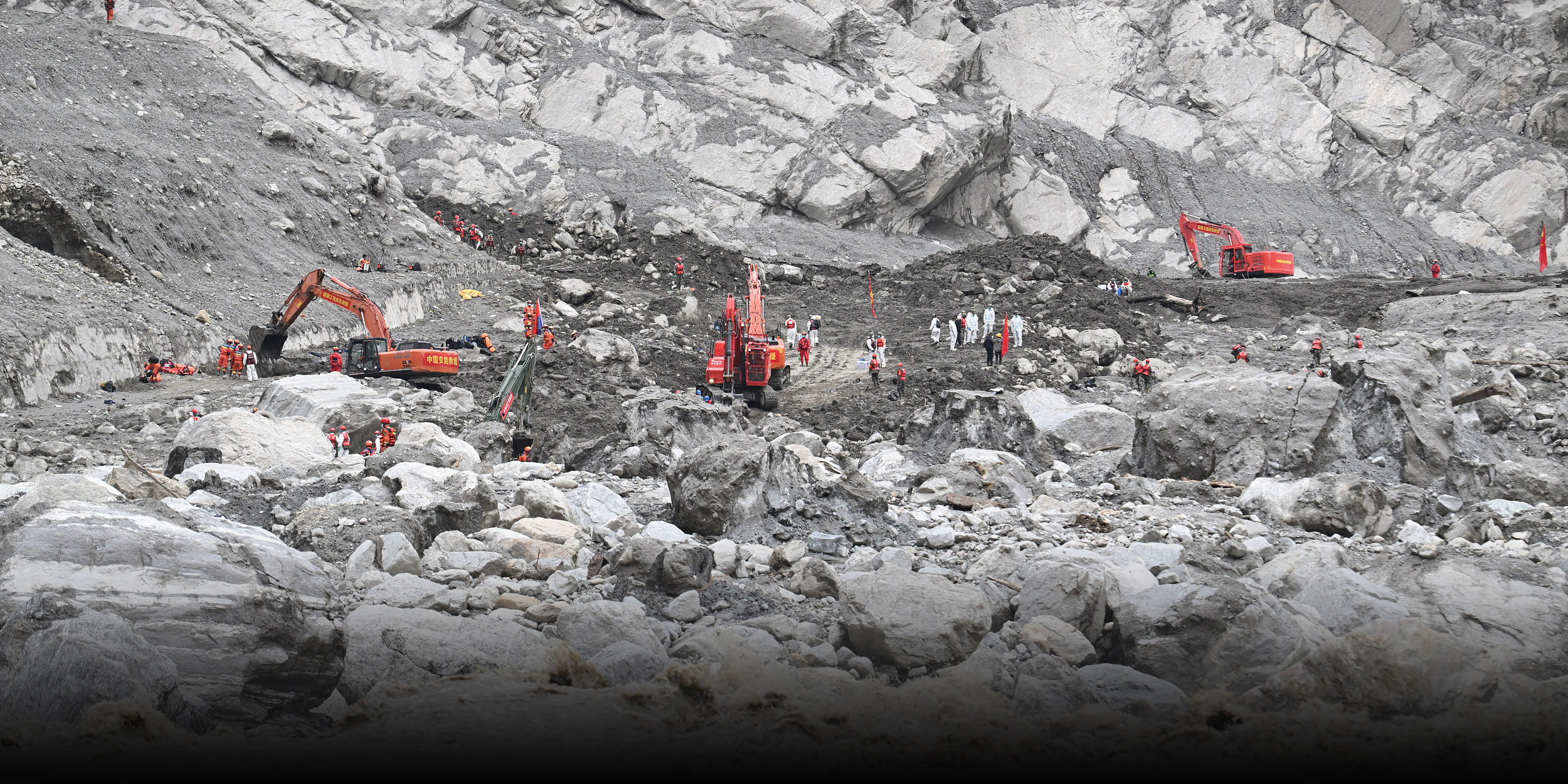
Yet that progress came to a violent halt on the morning of Aug. 26, when a flash flood caused by a mountain glacier ripped through the port in Shigatse, in China’s southwestern Xizang Autonomous Region. As of Sept. 2, the disaster had killed at least 1,204 in Nepal and 21 in China, according to Xinhua News Agency. Almost 5,000 people remain missing, including 546 in Gyirong.
He, who runs a photo studio in the regional capital, Lhasa, was in Beijing when he heard the news. Over the years, he had gotten to know more than 20 people working at the port, including customs and immigration officials, firefighters, and disease-control workers. He began hurriedly searching through his phone contacts.
“Are you safe? Please reply when you see this. I’m really worried,” he texted them. Most of his messages went unanswered.
Nestled in a deep, winding valley at the foot of the Himalayas, about 100 kilometers from the Nepalese capital, Kathmandu, China’s Gyirong County is referred to as “the back garden of Mount Qomolangma” — or Mount Everest, as it’s known in the West. The land port there is historically among the largest for trade between China and Nepal. After opening for bilateral customs clearance in 2014, the volume of goods passing through has increased rapidly.
“On one side of the port was a huge parking lot, where vehicles from both countries waited for inspection,” He recalls. “Next to the lot were several white buildings, four or five floors each, where the on-duty staff lived.”
Across from the lot was a police station and a row of small stores including a supermarket run by a middle-aged couple from the neighboring Sichuan province, a souvenir shop run by a Nepalese merchant, and three restaurants.
“Most visitors were tourists who took a quick photo at the border gate and left,” says the 50-year-old photographer. “There wasn’t much demand for a bustling commercial street. But the port staff stayed year-round, and these outlets were their only options for shopping and dining.”
Many of these border officials are among the missing.
With the flash flood destroying about three kilometers of the highway leading to Gyirong, it took two days for the first rescue teams from Xizang and Sichuan to reach the disaster zone. The highway was reportedly reopened on Sept. 2, allowing access to more rescuers, emergency supplies, and heavy machinery.
A warm welcome
The first reply that He received was from a Tibetan friend working at the port’s disease-control station. He had requested the day off on Aug. 26 and gone into town, narrowly escaping the massive torrent of rock, ice, and water that had wiped out his workplace.
The photographer offered to transfer some money so that his friend could purchase food and emergency supplies and bring them to the port, but he declined. “All the roads over there are blocked,” he replied. “The rescue teams are still using bulldozers and excavators to clear a path, moving forward inch by inch.”
After two sleepless nights, He set off from Beijing for Gyirong on the morning of Aug. 28. He had no idea how he would help — he just knew he had to go.
Since the disaster, the Gyirong Entry-Exit Border Inspection Station’s official channel on the WeChat messaging platform has been inundated with messages from well-wishers.
Many staff at the port are in their early 30s and hail from various parts of China. Far from their families, most live quiet, monotonous lives.
He Xu once wandered into the staff dormitories and noted the austerity of the rooms, with just two beds, a desk, and simple storage cabinets. The housing complex had a recreation room with table tennis and other sports facilities, but he’d never seen anyone using them. “The most typical thing I saw staff doing after work was calling their families,” he says.
The workers rarely ventured far, He says, leaving them little opportunity to appreciate the valley scenery — so he decided his lens would be their “eyes.” One person wanted to see a kiang, an indigenous wild ass; another, the splendor of Ngari prefecture, a 15-hour drive west; another, the view from a 4,500-meter platform in the Himalayas just an hour away. Each time, He would capture what they asked for and share the pictures on WeChat.
The customs staff rotated every three or four days. Off-duty workers are accommodated in the county seat, about 90 minutes away by bus, where they can enjoy more variety in terms of meals, shopping, and entertainment.
Those who have passed through Gyirong Port often speak of the “pleasant, helpful” nature of the customs and security personnel there.
Wen Lili from China’s northwestern Shaanxi province visited in early August. She remembers a young police officer who helped suggest the best places to take photos — the checkpoint, boundary marker, and the Friendship Bridge over the border — and where to exchange Chinese renminbi for Nepalese rupees. “It’s such a tiny place, and he told me everything there was to see,” she says.
He Xu says that, one time, his pickup truck was dangerously low on fuel, and a police officer drove more than 40 kilometers to the nearest gas station to bring him a full jerry can.
Two years ago, He joined a customs officer named Dorje and some of his friends for a meal in town. Dorje came from Maizhokunggar County, more than 800 kilometers from Gyirong, and was 10 years from retirement. With a beaming smile, he had talked of his three children, who had all gone to work in major cities.
With the savings he had accumulated, Dorje had planned to return to his hometown, buy some cattle and sheep, and spend his days tending them with his wife. It was his ideal life, he’d said.
Two-way street
Ma Baoxiang, who runs a general store in Gyirong, would often drive the 20 kilometers to the port to shoot videos for his social media channel.
Having made countless trips, he had become familiar with its rhythms: mornings were busiest, as tourists and truck drivers rushed to cross the border before lunch, although crowds could also swell in the afternoon, with vehicles sometimes lining the road. Most were trucks bearing Nepalese license plates, but Ma says that in recent years he has noticed an increase in travelers crossing the border in private cars.
The Bangxing Logistics Park, a 40-minute drive from the port, is the initial destination for most goods arriving from across the border. The facility gets so busy that drivers can be stuck waiting for up to two days to load or unload their cargo.
Nepalese residents near the border with exit-entry permits would also regularly pass through the port to stock up on clothes, daily necessities, and food from the stores in Gyirong.
“You often see Nepalese merchants buying wholesale goods in town,” says Ma, who every few months goes the other way to buy copperware, handicrafts, tea, and other specialty products, which he ships home to sell to tourists.
Trade at Gyirong Port once largely consisted of small businesses run by local residents. In April 2015, when an earthquake in Nepal damaged facilities at the larger Zhangmu Port, Gyirong became the primary China-Nepal border crossing. It was expanded into an international port in 2017.
By 2024, the value of imports and exports passing through Gyirong reached 4.24 billion yuan ($632 million), the highest among all the ports in Xizang.
Ma Qi, the local branch manager of Musa International Logistics, says his company had at least a dozen trucks en route to the port when the disaster struck on Aug. 26. He immediately told the drivers to pull over and wait, and then contacted nearby warehouses to arrange 6,000 square meters of emergency storage for their cargo.
“Gyirong is the best port,” says Ma Qi, who has worked in cross-border export logistics for 13 years. His company exports 400 to 500 cubic meters of goods a day, including clothing, hardware, small household appliances, construction machinery for bridge and tunnel projects, and electric vehicles. He describes the port as a “lifeline.”
The growth in tourists has also helped turn Gyirong into an economic hub, bringing many restaurants and hotels.
“After the mudslide, Gyirong suddenly emptied out,” says Lin Tian, who has owned a store in the county seat selling Nepalese specialty goods for the past five years. “The only people here are residents and the people working or running shops.”
Locals are no strangers to floods, earthquakes, and other natural disasters. It has become an inevitable part of life.
When a mudslide triggered flooding on both sides of the border in July last year, Gyirong Port was closed for nearly six months, forcing logistics companies to shift operations to smaller ports.
“These past few days, the government has been coordinating with us to register and report the cargo stranded at the port. They will arrange for it to be shipped out through the Zhangmu and Lizi ports instead,” says Ma Qi. In the meantime, he is mobilizing resources and coordinating with relief organizations in Lhasa and Shigatse to help transport emergency supplies to the disaster zone.
In late 2024, Gyirong was hit by landslides, leaving many port workers stranded in town with no power for more than a week. The mud in some places was shin-deep.
He Xu recalls asking several port staff whether they feared natural disasters. One simply smiled and replied, “I’m not worried. We’ve always made it through before.”
This time, He wasn’t so sure. In the early hours of Aug. 28, he finally received another message from a contact at the port, this time from a police officer. “I’m in downtown Shigatse. I’m fine,” it said.
Reading it, he felt his anxiety ease a little. Yet many others have remained silent.
(Due to privacy concerns, Wen Lili, Dorje, and Lin Tian are pseudonyms.)
Reported by Yang Shuyuan, Zhang Lingyun, and Wang Qian.
A version of this article originally appeared in Original (Jiefang Daily). It has been translated and edited for brevity and clarity, and is republished here with permission.
Translator: Carrie Davies; editors: Wang Juyi and Hao Qibao.
(Header image: Search and rescue personnel look for survivors in Gyirong Port, Xizang Autonomous Region, Sept. 2, 2026. VCG)